
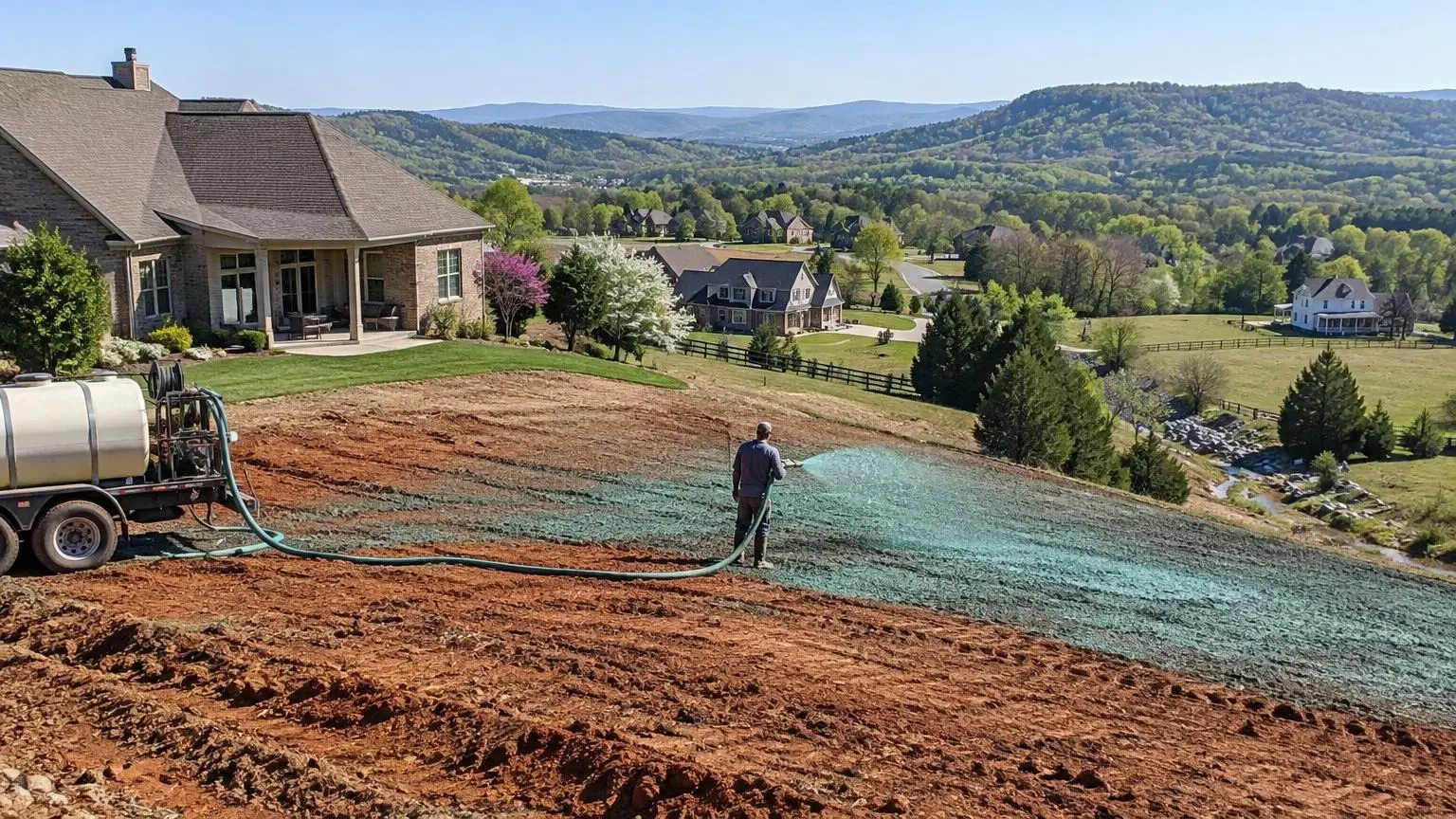
Hills, clay and spring storms
Slope & Erosion Control in Nashville, TN
Holding soil on steep yards, cut banks, swales and ditches until grass takes over the job.
- Free site visits and written quotes
- Seed mix chosen for the season: fescue in fall, warm-season grass in late spring
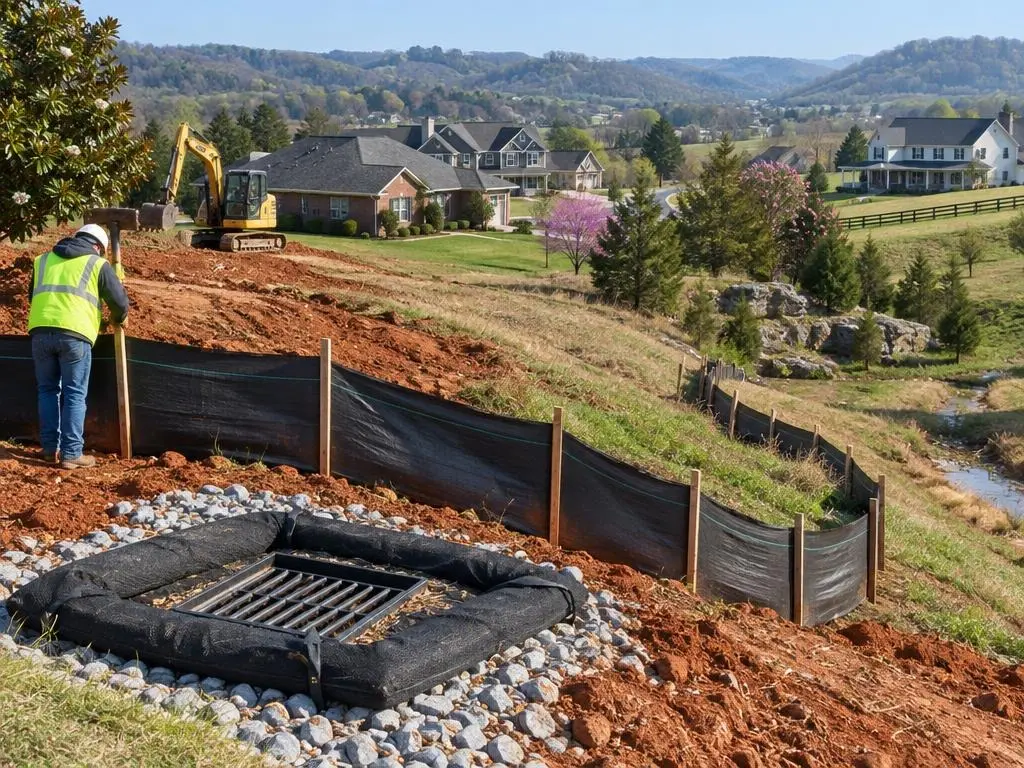
- Erosion control and silt fence from the same crew that seeds
Keeping Hillside Soil Where It Belongs
Slope and erosion control is about buying time on bare ground around Nashville. Grass roots will eventually hold a slope together, but it takes weeks to months for them to get there, and a single heavy storm can carve a bank into gullies before then. Our erosion control services cover that gap with hydromulch, erosion control blankets, straw blankets and bonded fiber matrix, chosen by how steep the ground is and how much water crosses it. We work on residential hillsides, cut banks behind new houses, drainage swales, roadside ditches and the slopes around commercial pads and detention areas.
Why Nashville slopes wash
The city sits where the Nashville Basin meets the Highland Rim, and elevations inside Nashville range from about 385 feet at the Cumberland River to 1,163 feet at Radnor Lake. That means plenty of sloped lots. The airport's 1991 to 2020 normals show about 50.5 inches of precipitation a year, with the wettest months from February through July and May on top. Spring and fall bring severe thunderstorms and flash flooding. Put that rain on a freshly cut bank of clay subsoil and it runs off fast. Clay particles are fine enough to stay suspended, so muddy water leaves the yard and heads for the street, a storm inlet or the nearest creek.
Matching the method to the slope
- Hydromulch (hydro mulching). Standard wood or paper fiber mulch sprayed with seed. Good for gentle to moderate slopes and the starting point on most lawns.
- Heavier mulch with tackifier. More fiber per acre and extra binder for steeper ground that still sees sheet flow, not channel flow.
- Bonded fiber matrix. A sprayed mulch that bonds into a continuous blanket-like layer when it dries. It holds on slopes where standard mulch would slide, and it goes on with the same truck.
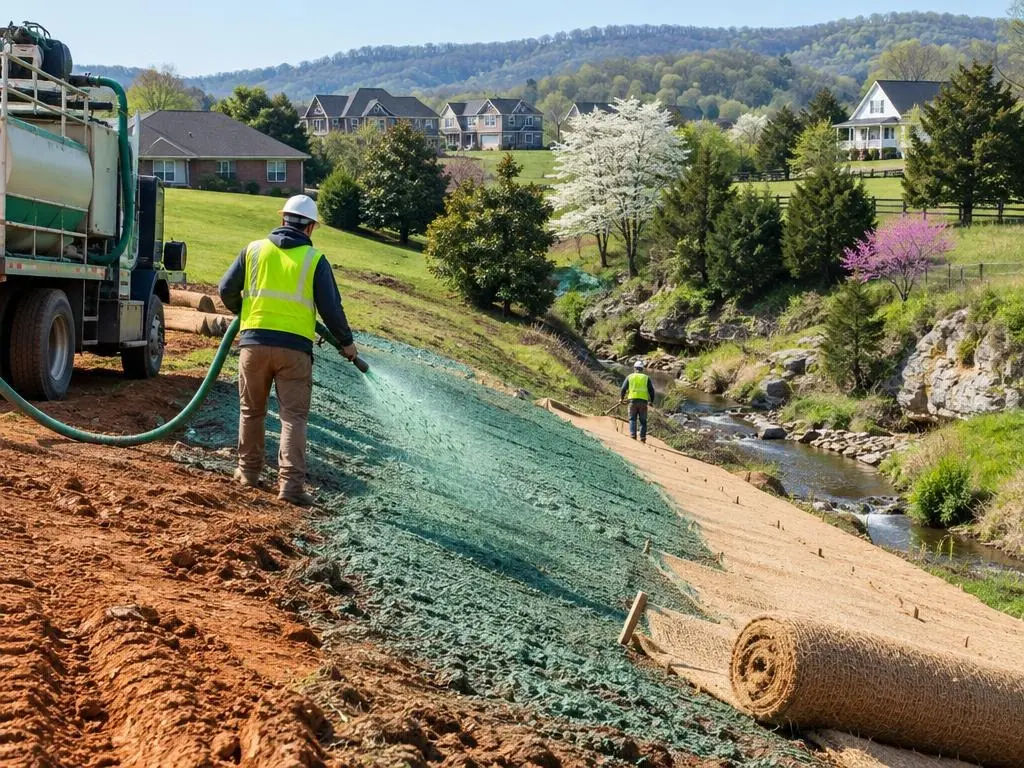
- Erosion control blankets. Rolled blankets of straw, coir, or a straw-coconut mix, staked over seeded soil. These go in swales, ditches and the steepest banks, where water concentrates and a sprayed product would wash out.
On many jobs we use two or three of these on the same property: mulch on the yard, blankets in the swale, and heavier mulch on the bank between.
Swales, ditches and downspouts
Most erosion we are called about is not a whole hillside failing. It is a downspout discharging onto bare dirt, a swale between two houses carrying a neighborhood's runoff, or a roadside ditch cutting deeper every storm. Those spots need the water slowed and the channel lined. Blankets staked along the flow line, sometimes with a little regrading first to spread the flow out, usually fix it. If a channel needs rock or a pipe, we say so.
Metro rules and steep fill
Metro Water Services' grading permit guidance for Davidson County lists, among the conditions for skipping a permit, no fill placed on ground steeper than 5 horizontal to 1 vertical and no final slopes steeper than 1 vertical to 3 horizontal, unless calculations justify stabilization measures for steeper slopes. Bare areas are also expected to be stabilized within 15 days. If your project is near those limits, we will tell you before anything is disturbed.
When to call us
Call when you see rills or gullies forming, mulch or seed collecting at the bottom of the yard, muddy water leaving the property after rain, or a bank behind a new house that has never grown grass. The earlier we catch it, the smaller the fix. Erosion control contractors are often called after the soil is gone; it is cheaper to call before. Get a free estimate
Erosion Control Options
Products and fixes we use on Nashville-area slopes and channels.
Hydromulch with seed
Wood or paper fiber mulch sprayed with seed and fertilizer for gentle to moderate slopes.
Bonded fiber matrix
A sprayed mulch that dries into a bonded layer for steeper banks.
Straw erosion control blankets
Single or double netted straw blankets staked over seed on slopes and in swales.
Coir and straw-coconut blankets
Longer-lasting blankets for channels and banks that need protection for more than one season.
Swale and ditch lining
Regrading and blanket lining along the flow line to stop cutting.
Downspout outlet fixes
Spreading or redirecting roof water so it stops cutting the yard.
Typical Erosion Control Costs
| Item | Typical range |
|---|---|
| Wood-fiber hydraulic mulch per 1,000 sq ft (state DOT 2025 pay rates) | $98 |
| 70/30 straw-coconut blanket, installed, per 1,000 sq ft (same list) | $468 |
| Coir blanket, installed, per 1,000 sq ft (same DOT list) | $532 |
| Extra for steep ground on a home hydroseeding job, a sq ft (HomeGuide) | $0.05 to $0.10 |
| Bonded fiber matrix | Quoted on site; no current published figure |
Unit rates come from the state DOT 2025 pay rates and include installation; they are not Nashville quotes. Slope length, access and how much water crosses the area all affect cost. Published cost data. Your actual price is the one in writing from us.
How We Stabilize a Slope
1. Read the water
We find where runoff enters, how it crosses the slope and where it leaves.
2. Fix the flow first
Downspouts redirected, swales shaped, rills filled and the surface roughened.
3. Seed
Seed and fertilizer go down with the right mulch for the slope.
4. Cover
Blankets staked in channels and on the steepest ground, or bonded fiber matrix sprayed.
5. Check after rain
We look at the first big storm's results and touch up anything that moved.
Why Choose Us for Slope & Erosion Control
Method by slope
We pick mulch, BFM or blankets for each part of the property, not one product for all of it.
Water first
We fix where the water goes before we cover the soil.
Seed included
Every erosion fix ends with grass that will hold the slope long term.
Slope & Erosion Control Questions
What is the best erosion control for a steep yard?
It depends on how steep and how much water crosses it. Moderate slopes often hold with heavier hydromulch and tackifier. Steeper banks may need bonded fiber matrix, and swales or channels usually need staked blankets.
Is bonded fiber matrix better than straw blankets?
They solve different problems. Bonded fiber matrix sprays on and covers irregular slopes well, while blankets handle concentrated flow in swales and ditches better. Many jobs use both.
How long do erosion control blankets last?
Straw blankets are meant to break down as the grass establishes, while coir blankets last longer for channels and banks that need more time. We pick the product by how long the site needs protection.
Why does my new grass keep washing off the slope?
Usually water is concentrating in one place, the mulch was too light for the slope, or the soil surface was sealed and smooth. Fixing the water path and using heavier mulch or blankets solves most cases.
Slope & Erosion Control Service Areas
- Hydroseeding in Nashville, TN
- Hydroseeding in Franklin, TN
- Hydroseeding in Brentwood, TN
- Hydroseeding in Murfreesboro, TN
- Hydroseeding in Smyrna, TN
- Hydroseeding in La Vergne, TN
- Hydroseeding in Hendersonville, TN
- Hydroseeding in Gallatin, TN
- Hydroseeding in Mount Juliet, TN
- Hydroseeding in Lebanon, TN
- Hydroseeding in Spring Hill, TN
- Hydroseeding in Nolensville, TN
- Hydroseeding in Thompson's Station, TN
- Hydroseeding in Goodlettsville, TN
- Hydroseeding in White House, TN
- Hydroseeding in Springfield, TN
- Hydroseeding in Columbia, TN
- Hydroseeding in Fairview, TN
- Hydroseeding in Dickson, TN
- Hydroseeding in Portland, TN
- Hydroseeding in Ashland City, TN
- Hydroseeding in Pleasant View, TN
- Hydroseeding in Kingston Springs, TN
Get a Slope & Erosion Control Estimate
Free erosion control site visits in Nashville and nearby towns.